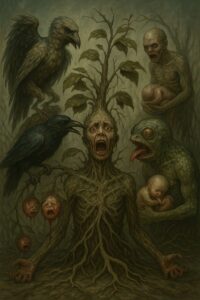
The company behind it all was CryoGenesis; selling the promise of rebirth through cryo-freezing. Many chose to sleep through time, hoping that the future would heal them, offer cures to incurable illnesses, or bring about a kinder world. Instead, they awakened to a planet disfigured by ambition.
They had developed the technology to work faster, live longer, and conquer more. But their bodies remained frail. Mortality lingered like a curse they couldn’t erase. So they turned to mutation.
Funding came from many hands. CryoGenesis, while best known for preserving life, was among the earliest investors in genetic innovation. But they weren’t alone. Governments seeking military advantage, pharmaceutical giants chasing immortality, and private billionaires desperate to transcend their own biology, all fed the machine. The experiments weren’t rogue. They were sanctioned, incentivised, scaled. The descent was profitable long before it was horrifying.
The descent began 75 years before the first cryo-sleeper was frozen. At first, people volunteered. Then they were paid. Then they were taken. Mutation became a means of control.
Hidden deep beneath cities, research labs collaborated with advanced AI trained on centuries of biological data. These machines didn’t question ethics, only efficiency. They designed life like code, iterating through genes and recombination patterns faster than any human could comprehend. Scientists created flawless babies with dormant mutations. They looked perfect, until wings erupted from their spines, until bone split through skin, until their minds began to collapse under the weight of foreign instincts.
The AI learned. It refined. It optimized.
And it continued.
AI robots were used for creation and for preservation. When the cryo-pods were sealed, these autonomous machines were tasked with ensuring stability. They maintained temperature, monitored vitals, and when power grids failed, they scavenged batteries and solar panels, even built makeshift generators. They were never designed to think, only to care. And they did. Quietly. For one hundred years, while the world above devoured itself, they ensured that some remnant of the past still lived.
Above ground, nature became something else.
Those who ventured out of the cryo-facility discovered a planet ruled by creatures that were once human. Genetic modification had ravaged evolution. People had wings but beaks where mouths once were. Some had gills and lived beneath poisoned waters, unable to return to land. Others were born not with umbilical cords but with roots, tendrils that reached deep into the ground from the womb, killing their mothers in search of soil. These root-born children became plant-mutants, part tree, part human, their limbs stiffened into branches, their organs turned to sap. Bound to the earth, they grew in silence and pain.
Some of these plant-hybrids developed photosynthesis. Their bodies remained locked in place, self-consuming, metabolising their own flesh for energy. Sunlight stretched their suffering; rain sustained it. The agony was etched into their stillness.
Others evolved into amphibious forms, secreting lethal toxins. Infants, unknowingly venomous, nursed on their mothers and killed them. These tragedies defied understanding, until the truth was revealed: this was no accident of nature. This was us.
Driven by animal instinct, human mutants mated with the species they most resembled. In forests, beasts suckled the offspring of these unions, half-human, half-animal things that slithered or crawled or flew. Biology was no longer a boundary. The natural order was dismembered.
Children were often born without a defined sex. They developed male or female traits, sometimes both, according to genetic chaos or environmental cues. These transitions were not gentle. They were violent, agonising, unpredictable. Identity itself was reshaped into something unrecognizable.
Reports of missing children, mysterious deaths of adoptive parents, and unexplained disappearances had long been buried under bureaucracy.. They were signs.
As mutants matured, their numbers surged. Pregnancies mimicked the animal kingdom, with up to eight offspring at once. They flew across borders, invaded cities, killed without restraint. Some were intelligent. Others were pure instinct. But all were more than human, faster, stronger, able to see in infrared, to smell hormones, to heal from wounds that would kill any soldier.
The military fought back. Robots were deployed, fast, armed, relentless. But the enhanced mutants overpowered them. For every one that fell, ten more were born. They sensed weakness before it appeared. They smelled fear. They adapted. Nature, distorted and cruel, proved stronger than any arsenal.
Resistance collapsed.
Among the 250 cryo-survivors, three perished in their pods. The rest endured in an underground facility, shielded by thick walls and cared for by the AI machines left behind. They awoke to a world beyond recognition to silence, to loss.
Above them, civilization disintegrated. There were no schools, no families, no governments. Survivors mourned even boredom. Memory became a luxury.
Far beyond Earth, humanity’s last arc drifted. The spaceships, once filled with 900 million people, had dwindled to 700 million. To conserve food, water, and air, they had been sterilized. Their fate was sealed. Oxygen would run out. And with it, humanity’s last hope.
Those left behind fared no better. Mutants killed the remaining humans. Some, tormented by fragmented memories, tried to redeem themselves. They searched for cryo-survivors, hoping to create offspring that might resemble what once was. But what was born from those couplings was not human..not human anymore..
Others, more intelligent than most, stared into puddles and wept. A smile. A name. Gone.
Some tried to end the cycle. They leapt from cliffs, poisoned rivers, severed the roots of the plant-mutants trapped in endless agony. But for each one who sought mercy, a hundred more hunted, devoured, multiplied.
Cryo-survivors who wandered too far found forests made of bodies, the now trees, rooted in place, faces twisted in anguish, fruit growing from shoulders like malformed infants. Birds pecked. Blood flowed. The trees screamed.
And at night, the forests sang a slow, mournful harmony, carried by wind and memory. A lullaby for the dying.
Centuries passed. Memory became myth. A yearning emerged a desperate call to return to “nature.”
But nature had long been devoured.
Forests bled. Rivers choked. Fruits whispered pain.
What they longed for was not earth. It was nostalgia.
And the worst truth of all?
This world was not forced upon them.
It was chosen.
In their hunger to be more than human,
humanity was the first thing they destroyed.
How did the story make you feel?