The forest pulsed with life. The canopy swayed to the rhythm of the wind, playing games of light and shadow with the sun. Birds sang in melodies never quite the same, their notes woven with the rustling of leaves. Canopies filtered sunlight like stained glass, casting golden hues across moss-covered paths. The stream nearby murmured softly, its voice mingling with the distant cries of unseen creatures. The forest danced in harmony.
Every step taken beneath the canopy brought a strange sense of calm. Humans who wandered in felt it – breath steadier, heart lighter, like something unseen had brushed away their burdens. Some whispered it was her doing, the witch. But it wasn’t. It was balance. It was the unspoken pact of a world left untouched, a sacred order few could see, but all could feel.
No one hunted here. Not because they were forbidden and those who tried would find the same wounds they inflicted upon animals mirrored on themselves. The witch did not forbid it, but her forest had its own laws. Humans came only to harvest a few fruits, feeling watched by the balance she upheld. In this place, nature thrived in symbiosis, flowers, beasts, and wind coexisting like old souls sharing the same breath.
And in this sanctuary, the witch was only ever a passing shadow.
She gave potions to those in pain – to soothe fevers, mend broken bones, quiet anxious minds, and ease troubled sleep. Remedies for coughs, pain, grief. She asked for nothing in return. She helped animals, tended to the forest, and welcomed children with open arms. But she turned away those with wicked hearts – the corrupt, the cruel, the unkind.
She believed that even the darkest soul could be reached with care. But she never let herself be deceived by false repentance.
Then came the deaths.
It began with one – a man found lifeless at the forest’s edge, clutching a familiar vial. Two days later, an elder who had once begged at her doorstep was found collapsed near his home. Over the span of a week, eight were dead – three women, five men. Adults known for the cruelty they’d sowed across seasons.
With each body, a vial. Empty. Identical to the ones the witch had once offered – but never to them. They had taken them in secret, stolen them out of greed, believing her potions held power.
At first, the village whispered. Then they divided.
Some claimed it was justice. That the witch was tired of the wicked. Others defended her – she had helped their children, asked for nothing in return.
Some went to the woods to seek her out. A few begged for answers.
“Are you responsible for the deaths?” they asked. “Why are your vials there? Have you been poisoning them?”
She looked at them, calmly. “No,” she said, brushing the accusations away like a breeze through leaves. She owed them no explanations, and yet the sadness in her eyes said more than words ever could.
“She’s punishing us,” the whispers grew louder. “Strange how no children have died.”
“Wait until she comes for your family,” one spat.
And then – two days later – one of the women who defended the witch found her eldest son dead. A vial in his pocket.
That was enough. It didn’t matter that she had never harmed them. That she had healed, not hurt.
During the day, they marched with burning torches, fire at their side to repel the creatures of the forest who tried to stop them. Wolves snarled and leapt, birds screamed from treetops, but fire won over fury. Out of a village of fewer than two hundred, nearly one hundred and twenty stormed into the woods.
They found her where she always was – near the grove where she fed children the juiciest fruits from her trees.
They dragged her barefoot through the mud. No trial. No mercy.
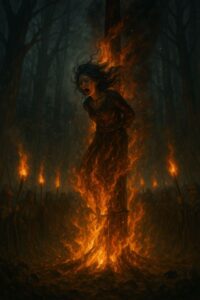
They tied her to the stake. Flames hungrily licked her legs, climbing higher with each breath she took.
Her skin blistered and peeled, her hair caught fire, her lips cracked open from heat – yet she did not scream.
Her flesh split, blackened, curled into itself. But still – not a word.
Only a few tears slid down her cheeks from knowing this was always how her story would end.
She did not beg.
The fire roared, devouring her. But the wolves howled louder. The forest trembled. Winds whipped through the trees, hurling dirt and leaves, as if nature itself rose in protest.
But it was too late. The flames did not stop.
The crowd watched her burn and felt safer for it.
But safety, like truth, can be deceiving.
That very night, more deaths. “She has cursed us,” someone screamed. “The bitch! She’s taking us with her.” Another man collapsed before dawn. A mother was found breathless beside her child’s bed. Day after day, bodies fell one after another. Until not one remained.
Oliver was eleven. With wide, curious eyes and a face as gentle as morning light, he looked every bit the innocent child. He was terribly shy, often trailing behind his three teasing sisters. Deeply loved by his parents, he barely spoke to others and preferred the quiet of the woods.
One full moon before the first death, he wandered alone into Kevalina’s woods.
She sensed his pain – not visible, but deeply rooted.
She gave him a potion, one meant only for him, to be taken on the first day of every full moon.
After the first sip, something shifted in him. He grew gentle. Made friends. The villagers whispered of luck, of magic. His parents believed it too.
They never returned to Kevalina for more. They thought he was cured by now.
They simply refilled the vial with some fruit juice.
And by so doing, the potion meant to heal was replaced with poison what would kill.
The morning after the next full moon, the first body was found. The deaths began.
The village blamed the witch. Burned her.
And Oliver – unnoticed – continued what had been set in motion.
He poisoned the rest. Then drank it himself.
Now, nothing remains. No villagers. No animals.
The village is gone.
And when fear replaces truth, and judgment overrides compassion.
There can never be peace.
How did the story make you feel?